Service Requirements in Oklahoma
Oklahoma's College Preparatory/Work Ready Curriculum requires every public high school student to participate in a service-learning or work-based learning activity at least once in grades 9 through 12. The state sets a participation requirement rather than an hour count, so schools decide what a qualifying experience looks like and how to document it. Many Oklahoma schools go further with their own hour requirements, grade-level expectations, honor society service, and graduation cords.
Not a public high school where this requirement applies?
Helper Helper isn't just for state-mandated programs. We also power service hour tracking for National Honor Society and NJHS chapters, Key Club organizations, and Catholic and private high schools across Oklahoma that run their own service programs.
Oklahoma Success Story Cascia Hall Preparatory School
Cascia Hall Preparatory School · Private College Prep
“Prior to Helper Helper, our students had paper forms for their on site supervisors to sign, date and give their contact information. Helper Helper has streamlined the student's ease in recording their service. Faculty sponsors' time spent translating from service to grades has become less tedious.”
At Cascia Hall Preparatory School in Tulsa, service is part of the school's mission and identity, not just a line on the graduation checklist. For years the school ran that program on paper. Students carried forms to their service sites, collected a supervisor's signature, date, and contact information, and turned the forms in to be checked. The system worked, but it stopped at compliance.
Around the same time, school leadership was rethinking what service should mean. Instead of asking students to accumulate hours, Cascia Hall shifted its emphasis to what it calls "service and hours," with a requirement for each grade level that matches what students are ready to take on. Helper Helper gave the school a way to hold every grade to its own standard. Advisors set a goal for each class, students log service in the app, and the organizations they serve verify the hours directly.
The biggest change happened behind the scenes. Faculty sponsors used to spend considerable time translating stacks of service records into grades. With reports that show every student's progress at a glance, that work is far less tedious, and the time goes to mentoring students instead. Students benefit too. High achievers can document and showcase everything they do through a verified service transcript, while students meeting the minimum have a clear, consistent path to accountability. Since 2019, Cascia Hall students have logged more than 47,000 service hours in Helper Helper.
How Helper Helper Supports Oklahoma Schools

One Platform for Every Oklahoma Service Program
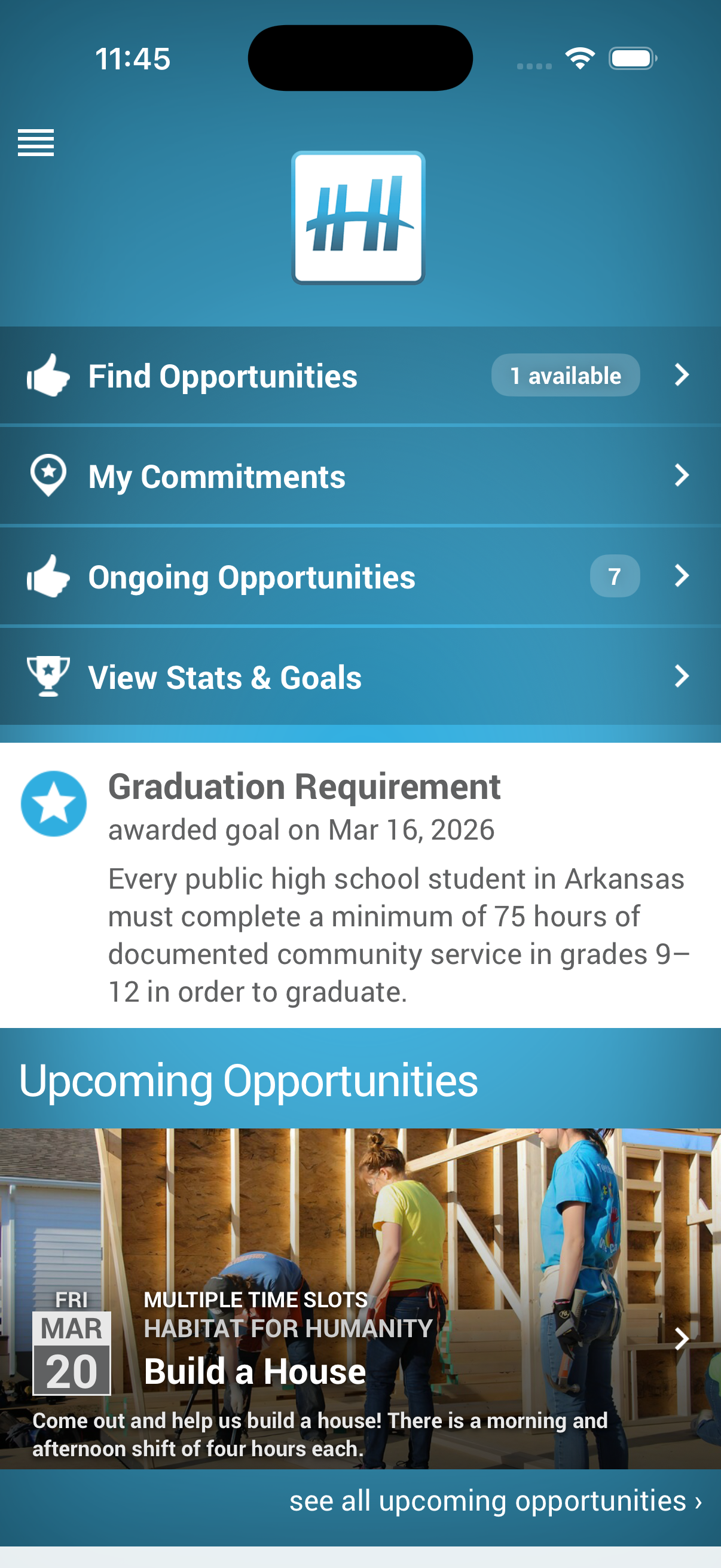
Oklahoma schools recognize service in different ways, and many run more than one program at once. Helper Helper handles all of them in one place:
- The state participation requirement: set a goal that counts completed service-learning or work-based learning experiences, not just hours, and see which students still need one before senior year
- School and grade-level hour requirements: run a different goal for each graduating class, or a yearly requirement alongside a four-year total, the way Cascia Hall matches expectations to each grade
- NHS, NJHS, and Key Club chapters: put each chapter on its own team so advisors track only their members, from middle school NJHS chapters to senior NHS induction
- Catholic and private school programs: custom categories separate parish, campus ministry, and community service, and students can write reflections on what each experience meant to them
- Work-based learning: log internships, job shadows, and career experiences beside volunteer hours, with photos and supervisor verification attached to each one
Getting Started
Helper Helper integrates directly with the student information systems (SIS) and single sign-on (SSO) providers your school already uses, including Google for Education, Microsoft, PowerSchool, ClassLink, Canvas, and more. Students sign in with their existing school credentials and rosters sync automatically.










Already tracking hours in spreadsheets, a homegrown database, or another platform? We'll import your existing data into Helper Helper at no additional charge so students don't lose credit for hours they've already completed.
Same-Day Support from Real People
No chatbots or ticket queues. When you need help, you’ll hear back the same day from Krista, Chelsea, or Matt. Our team knows schools and provides guided onboarding and Zoom trainings to get your program up and running.

Simple, Affordable Pricing
Helper Helper starts at $500 per year for up to 200 students and includes everything you need. Additional students cost $2.50 per student per year.
- Hour verification & reporting
- Goal tracking & real-time progress
- Service portfolios for students
- iOS, Android & web apps
Schedule a Demo
Pick a time that works for you. We’ll walk through how Helper Helper can serve your school or district and answer any questions you may have.
HECVAT-assessed, FERPA-compliant, encrypted in-transit and at-rest, hosted on AWS infrastructure.
This designation benefits both parties: for your school or district, it means you can deploy Helper Helper without the administrative burden of collecting individual parent consent for every student — the same way you onboard other essential technology platforms. For Helper Helper, it means we are held to the same strict data-handling standards as your own employees, giving your community confidence that student records are protected by the full weight of federal privacy law.
The FTC provides guidance confirming that schools may consent on behalf of parents in the educational context under COPPA. Please request to see our Notice of Data Practices for Children Under 13 and our Privacy Policy for further details.
The HECVAT was developed by the higher education community (EDUCAUSE) and is widely used by colleges and universities to assess the IT security, data protection, and privacy practices of third-party software vendors before adoption. While originally designed for higher ed, its comprehensive framework is equally valuable for K–12 schools and districts looking for a rigorous, standardized way to evaluate whether a vendor meets their security and compliance requirements.
AWS operates the most widely adopted and trusted cloud infrastructure in the world, with security practices that meet or exceed the requirements of federal agencies, financial institutions, and healthcare providers. Their data centers are protected by 24/7 on-site security, biometric access controls, redundant power and networking, and continuous monitoring.
AWS is independently audited against the most rigorous standards in the industry — including SOC 1, SOC 2, SOC 3, ISO 27001, FedRAMP, and PCI DSS — and provides industry-leading uptime guarantees backed by a 99.99% service-level agreement. This means your school can count on Helper Helper being available when students and advisors need it.
Administrators can be scoped to specific groups, schools, grade levels, or graduating classes — an NHS advisor sees only their NHS members, a school principal sees only their school, and a district coordinator sees the full district.
Outside community partners receive organization admin roles that let them post their own volunteer opportunities, manage sign-ups, and confirm attendance for events they host, without any visibility into student records, other organizations’ events, or school-internal data.
Helper Helper is fully FERPA-compliant, giving your community confidence that student records are protected by the full weight of federal privacy law. We never sell or share student data.
For Oklahoma schools, we sign your district's Student Data Privacy Agreement and comply with FERPA and the Oklahoma Student Data Accessibility, Transparency and Accountability Act (70 O.S. §3-168).
Oklahoma Schools Using Helper Helper
Bishop Kelley High School · Catholic High School
Bishop Kelley High School in Tulsa asks every student to complete 100 hours of Christian service over four years, 25 a year, and its Spirit of Service Award recognizes students who go far beyond that, up to 200 hours or more by senior year. The program has requirements a spreadsheet struggles with: at least 25 hours must be direct service to people experiencing poverty or vulnerability, juniors and seniors must serve 15 of their hours at the same site, and every hour must be logged and validated within the quarter it was served. Students record all of it in Helper Helper. Custom categories flag direct service, goals track both the graduation requirement and the award tiers, and quarterly reports show Campus Ministry exactly who is on pace.